Adityasinh
Software Engineer
About Me
Hi there! I'm Adityasinh Rathod, a dedicated and enthusiastic Computer Science major with a minor in Applied Mathematics at the New Jersey Institute of Technology (NJIT). I am a proud member of the NJIT Albert Dorman Honors College where I have maintained a 4.0 GPA and cultivated a strong academic and practical foundation. My journey includes experiences as a Software Engineer at Barclays, Prudential Financial, and Optum, Computer Science Tutor, Teaching Assistant, and Research Assistant at NJIT where I’ve developed a deep passion for machine learning, AI, and full-stack development.
Resume
Here is my education, work experience, & some skills I've got.
Experience
Barclays
Software Engineer Intern
Jun 2025 - Aug 2025
I built high-performance systems for algorithmic trading, including a real-time data pipeline delivering thousands of risk metrics per second, a low-latency solution that computed bond analytics 150x faster, and enhancements to a KDB+ publishing library that cut publishing errors by over a third.
Methix
AI Developer Intern
Jan 2025 - Mar 2025
I helped launch an AI platform that connected over 700 artists with scouts, leveraging Azure OpenAI, Cosmos DB, and Azure AI Search. Through an LRU cache and an optimized LangChain pipeline, I successfully cut OpenAI API costs by 40% and reduced latency by 25%.
Prudential Financial
Software Engineer Co-op
Sept 2024 - Dec 2024
Collaborated with the actuarial team to automate data-analysis workflows, which boosted report speed by 30%. I also developed a Python script to generate Excel reports from log files, improving error reporting time to less than 2 seconds, and enhanced API performance by 20% using AWS Lambda and optimized SQL queries.
Optum
TDP - Software Engineer Intern
June 2024 - August 2024
Automated batch data ingestion with Azure AI Services, improving validation and loading efficiency by 50%. I also created a React.js UI connected to Azure Blob Storage, enabling seamless migration operations for end users, which streamlined workflows, cutting processing time by 83.3% and saving $1M annually.
Education
New Jersey Institute of Technology
Albert Dorman Honors College
B.S. in Computer Science
Minor in Applied Mathematics
Sept 2022 - May 2026
NJIT
Machine Learning Research Assistant
Aug 2025 - Present
Investigating the computational circuits learned by a recurrent neural network (RNN) for algorithmic tasks. My work involves using Fourier analysis and Singular Value Decomposition (SVD) to demonstrate that the model discovers a sparse, low-rank solution.
NJIT
Computer Science Tutor
September 2023 - Present
Python, Java, C/C++, Assembly, x86 Architecture, Data Structures & Algorithms, Web Scraping, and Multithreading,.
NJIT
Teaching Assistant - CS288 - Intensive Programming in Linux
Jan 2025 - May 2025
C, Multithreading, POSIX, Pthreads, MPI, Python, Web Scraping.
NJIT
Machine Learning Researcher
May 2023 - April 2024
Led a student team of three to optimize wearable exoskeleton designs, successfully reducing the device's weight by 20%. Additionally, I applied feature-selection techniques for sensor placement, which improved gait-phase detection accuracy by 10%.
Skills & Expertise
Technologies
Projects
Some projects I have worked on.

Titan
Created a full-stack stock-trading web application where users can practice trading with a $10,000 virtual balance. It integrates the Yahoo Finance API for company summaries and price trend visualizations, with a Django backend managing login, registration, stock searches, and transactions. Python was used to configure the backend, PostgreSQL database was used to store user information and trade details, and the frontend was created using React.js.
https://titan-hazel.vercel.app/.
Machine Learning Algorithms in CUDA
My Machine Learning CUDA project focused on leveraging NVIDIA's CUDA platform to accelerate machine learning algorithms using GPUs. I developed highly optimized versions of common machine learning tasks, specifically a k-Nearest Neighbors (k-NN) algorithm and a linear regression model. The k-NN implementation was designed for parallel processing, allowing for very fast and accurate queries. For linear regression, I incorporated a per-feature gradient reduction technique to achieve efficient performance. A key part of the project involved building a complete pipeline on an NVIDIA Jetson Orin, handling data from initial parsing to managing memory between the CPU and GPU.
SFort95 Interpreter
Developed an interpreter for SFort95 by creating lexical analysis and parsing algorithms to accurately translate code into executable instructions. Implemented robust error handling to detect and report syntax errors, improving reliability. Optimized the interpreter's performance through algorithmic enhancements, resulting in faster execution and increased efficiency.
Minesweeper with AI
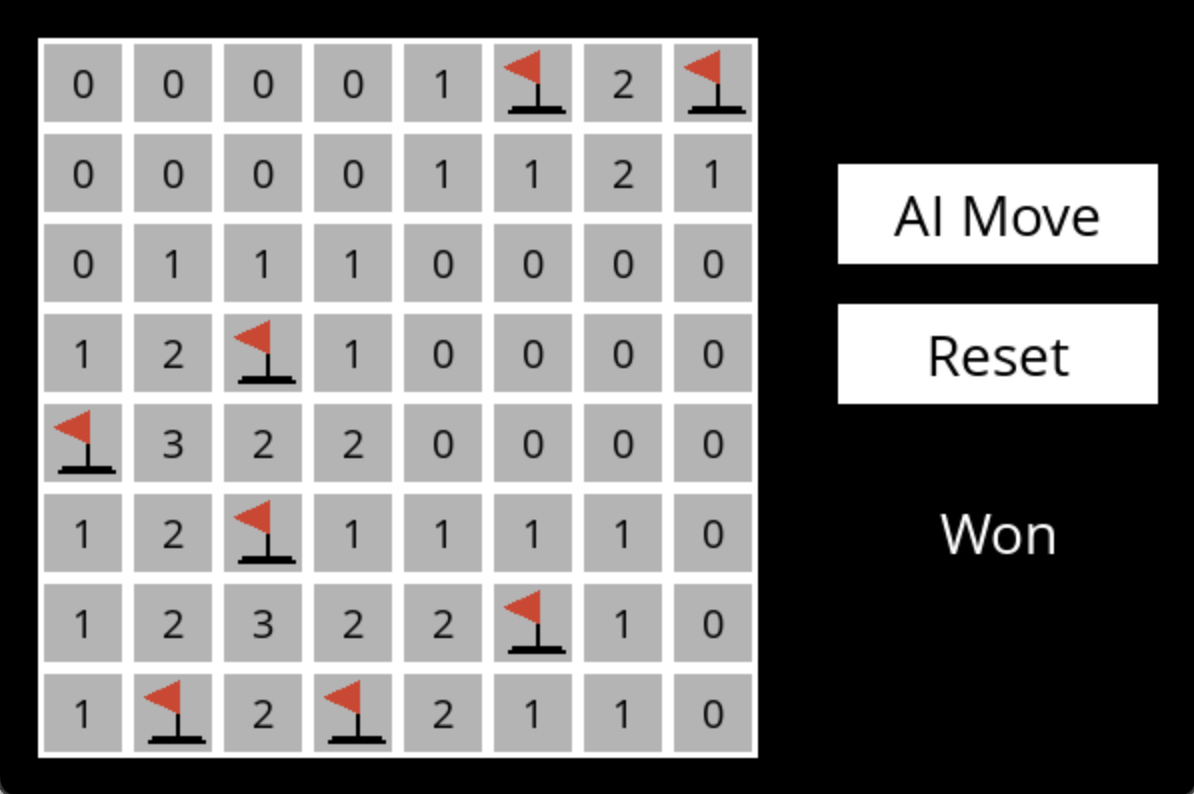
Developed a Minesweeper game with an AI agent capable of efficiently solving the board. The game includes a class that represents the Minesweeper board, initializing it with a specified height, width, and number of mines. Mines are placed randomly, and the board's state is represented textually. The AI agent employs logical reasoning to deduce safe moves and identify mine locations. It maintains knowledge of the game state through sentences that represent logical statements about the board. By leveraging this knowledge, the AI marks cells as safe or mines and updates its knowledge base, ensuring a strategic approach to solving the game. The project demonstrates a robust implementation of game mechanics and AI problem-solving techniques.